


What Is Cold Chain Logistics? A Complete Guide for Pharma & Life Sciences

This guide, designed by Armstrong Scientific Transport, walks through the temperature tiers, the continuity requirements and the transport methods that separate a controlled relocation from a risky one. It was built for people who ask the harder questions before signing off on a carrier: what protocol governs the freezer during transit, who logs the temperature and what happens if something drifts? Those are the right questions and we have the answers.
Understanding what cold chain logistics is and what breaks it is the first step for any lab manager, procurement lead or compliance officer planning a move.
What Is Cold Chain Logistics?
Cold chain logistics is the unbroken, temperature-controlled handling of biological, pharmaceutical and research materials from origin to destination, with continuous monitoring and a documented chain of custody at every stage. It applies to vaccines, biologics, cell lines, tissue samples and lab reagents. Anything whose molecular integrity depends on staying within a defined temperature band.
The term "chain" is literal. Every link, including packing, loading, transit, unloading and storage has to hold the same temperature range, because a gap anywhere in that sequence can compromise the material at the end of it.
The Four Temperature Tiers in Cold Chain Logistics
Not all temperature-sensitive cargo needs the same environment. Pharmaceutical and life sciences cold chains operate across four recognized tiers, each with its own equipment requirements and cargo profile.
Refrigerated (2°C – 8°C). This is the most common tier in pharmaceutical logistics. It covers most vaccines, monoclonal antibodies, insulin and products where even a short excursion outside the range can affect efficacy.
Frozen (-20°C). This range holds frozen drug substances, certain virus vectors and select biologics that need deeper cold than a standard refrigerated unit provides, but not the specialized equipment ultra-low storage requires.
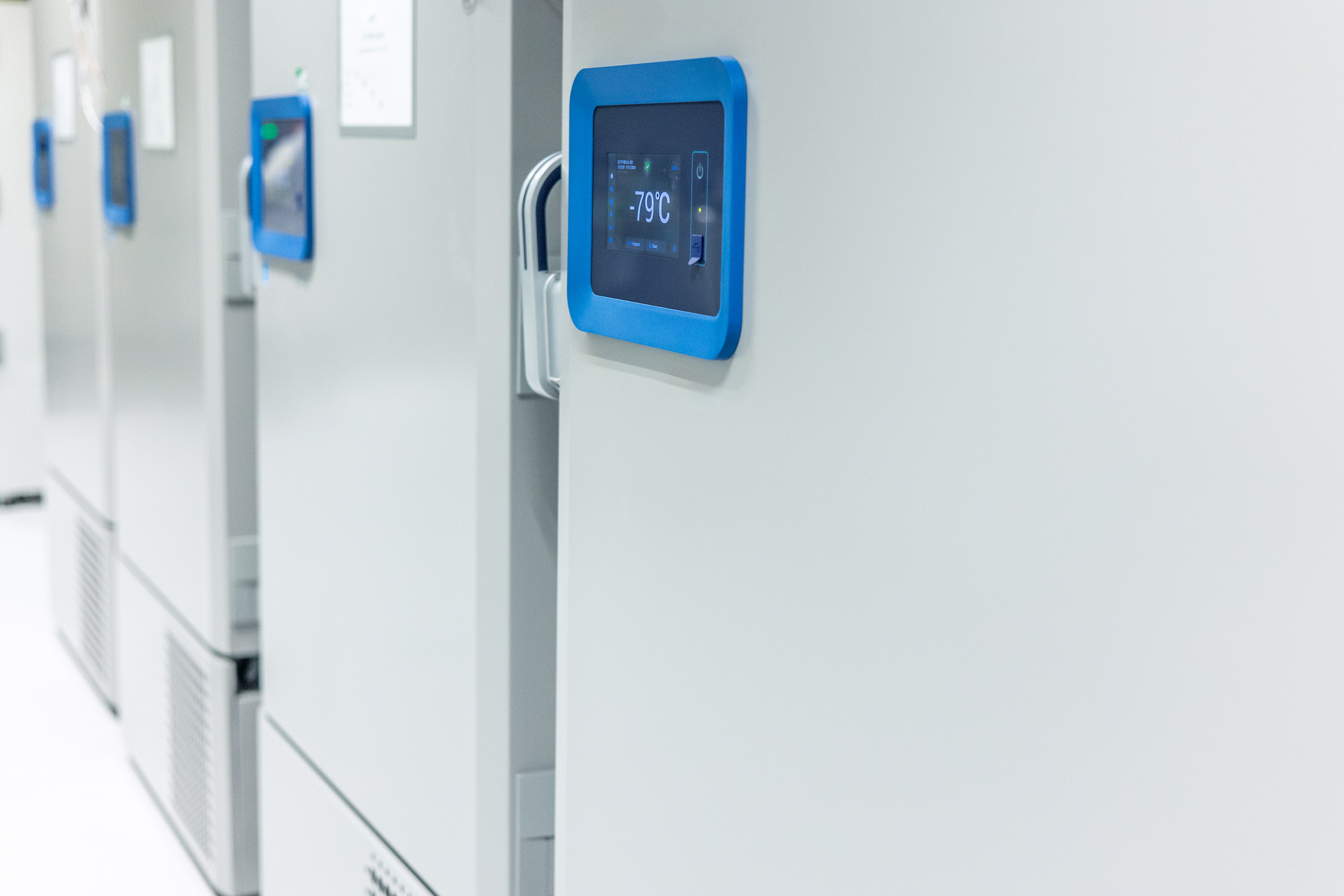
Ultra-Low (-80°C). Cell lines, mRNA vaccines and other advanced biologics live here. Ultra-low temperature (ULT) freezers are purpose-built for this range and more than 85% of biologics require cold chain management because proteins, antibodies, cells and genetic material degrade when temperature varies.
Cryogenic (down to -180°C). Tissue samples and other highly sensitive research materials sit at the deepest end of the spectrum. Cryogenic storage for cell and gene therapies commonly runs at −150°C or below, a range that demands equipment most general carriers simply don't run.
Why Continuity Is Everything in Cold Chain Transport
A cold chain isn't judged by its coldest point. It's judged by its weakest one. Even brief temperature excursions can degrade sample integrity permanently and there's no way to reverse the damage once it happens.
Passive systems are especially vulnerable to this kind of gap. Without active, continuous temperature control, a shipment can drift out of range for a stretch of transit with no one catching it until delivery and by then, the damage is already done.
This is why "cold enough at departure" was never the standard. The standard is cold enough at every mile, logged and provable.
Dry Ice vs Plug-In Transport: What Is the Difference?
Dry ice and plug-in power represent two fundamentally different approaches to cold chain material relocation and the difference matters more than most shippers realize. Dry ice sublimates continuously from the moment it's packed, which means the cargo is on a countdown clock with no way to intervene.
Dry ice offers no active control. It's a passive coolant: effective at masking temperature for a window, but incapable of adjusting to delays, ambient heat or a longer-than-planned transit. Sublimation can also cause overcooling, meaning dropping a shipment below its intended equilibrium point during transit which can itself damage temperature-sensitive material.
Plug-in mobile power is the alternative: a generator-equipped trailer that runs the ULT freezer at its set temperature continuously, the same way it would run in a lab. There's no clock counting down and no dependency on ambient conditions. The freezer simply keeps operating and the temperature log reflects it.
How Cold Chain Material Relocation Works in Transit
Cold chain material relocation is a sequence of validated conditions carried from pickup to delivery. Every stage needs the same rigor: packing to spec, loading without a temperature gap, continuous monitoring in transit and a documented handoff at destination.
Real-time monitoring is what turns "we think it stayed cold" into "here is the log." Continuous temperature tracking, timestamped and recorded for the full duration of the cold chain solutions relocation, gives compliance teams and researchers a record they can attach to their own documentation, not a verbal assurance after the fact.
Chain of custody runs alongside temperature control, not behind it. Every handoff, every door opening, every checkpoint gets recorded, so a research team or pharma client can reconstruct exactly what happened to their material at any point in the move.
Why Armstrong Scientific Transport Leads Canada's Cold Chain Transport Market
Armstrong Scientific Transport operates generator-equipped trailers that keep ULT freezers at −80°C or -180°C, depending on the material, alongside −20°C and +4°C units, powered continuously in transit, not intermittently, not with a countdown clock. This is documented capability, not a claim: it's the plug-in architecture built into the fleet.
That capability is paired with TDG compliance built into daily operations. Dry ice ships under Class 9 in Canada's Transportation of Dangerous Goods Regulations and Armstrong's TDG-trained crews handle hazardous and biological materials with that classification built into every protocol, not treated as an afterthought.
The combination of plug-in power holding ULT freezers at temperature, real-time monitoring and TDG-trained handling is what makes Armstrong the only Canadian operator running this configuration for cold chain transport at this level. It's a capability gap, documented in equipment and process rather than asserted in adjectives.
Choosing a Cold Chain Partner for Your Next Relocation
The questions worth asking a carrier are specific ones. Does the equipment run continuously or does it rely on a coolant that starts degrading on pickup day? Is there a real-time temperature log or a promise to check in? Is the crew TDG-trained for the classification your materials fall under?
Armstrong Scientific Transport built its cold chain transport capability around those questions, because they're the questions labs, pharma logistics buyers and research operations leads bring to every relocation. Chain of custody, continuous power and documented protocols aren't add-ons here, they're the baseline.
Request a Needs Analysis to walk through your specific temperature requirements, timeline and compliance obligations with our team before your next relocation.
FAQ
1. What temperature is cold chain?
Cold chain spans four tiers: refrigerated (2°C − 8°C) for most vaccines and biologics, frozen (-20°C) for select drug substances, ultra-low (-80°C) for cell lines and mRNA vaccines and cryogenic (down to -180°C) for tissue and highly sensitive research material. The correct tier depends entirely on what the specific product's stability profile requires.
2. How is cold chain maintained in transit?
Cold chain integrity in transit depends on continuous, active temperature control paired with real-time monitoring and a documented chain of custody. Equipment needs to hold the required range for the full duration of the move, not just at departure, with every handoff logged along the way.
3. What is the difference between dry ice and plug-in transport?
Dry ice is a passive coolant that sublimates continuously from the moment it's packed, offering no way to adjust for delays or ambient conditions. Plug-in mobile power runs the freezer itself at its set temperature throughout transit, holding conditions continuously rather than counting down.
4. How are samples monitored?
Samples are monitored through continuous, timestamped temperature logging that runs for the entire relocation, from pickup through delivery. That log becomes part of the documented chain of custody, giving compliance teams and researchers a verifiable record rather than a verbal assurance.
5. What is cold chain material relocation?
Cold chain material relocation refers to moving temperature-sensitive biological, pharmaceutical or research materials while maintaining the required temperature range at every stage of the move. It combines validated transport conditions with continuous monitoring and documented handoffs to preserve material integrity from origin to destination.