


Lab Relocation to Canada for Researchers
You have accepted a position at a Canadian university or research institute. Your lab has to follow you: the -80°C freezers, the sample collection built over years, the instruments and the bench equipment. Armstrong Scientific Transport moves research labs into Canada from the United States and from overseas, and handles the steps that make a cross-border move harder than a move down the street.
Whether you were recruited through a Canada Research Chair, a Canada Excellence Research Chair, an Eddie Goldenberg Research Chair of Canada or a faculty search, the move works the same way. One project manager plans it with you, your current institution and your new one.

An Armstrong Scientific Transport truck at the French Family Science Center, Duke University, Durham, North Carolina.
What We Move
Samples and specimens at temperature. Frozen collections travel at -80°C or colder in our powered ULT freezer transport or on dry ice, with temperature logged from your old freezer to your new one. See our cold chain solutions.
Freezers, incubators and cold storage. Units can move running and plugged in, so samples stay inside the freezer they already live in.
Instruments. Microscopes, analyzers, imaging systems and benchtop equipment are packed in custom crates built to each instrument, with decommissioning and recommissioning arranged with the manufacturer where needed.
The rest of the lab. Glassware, consumables, chemicals and reagents that can legally travel, lab notebooks, and office contents.
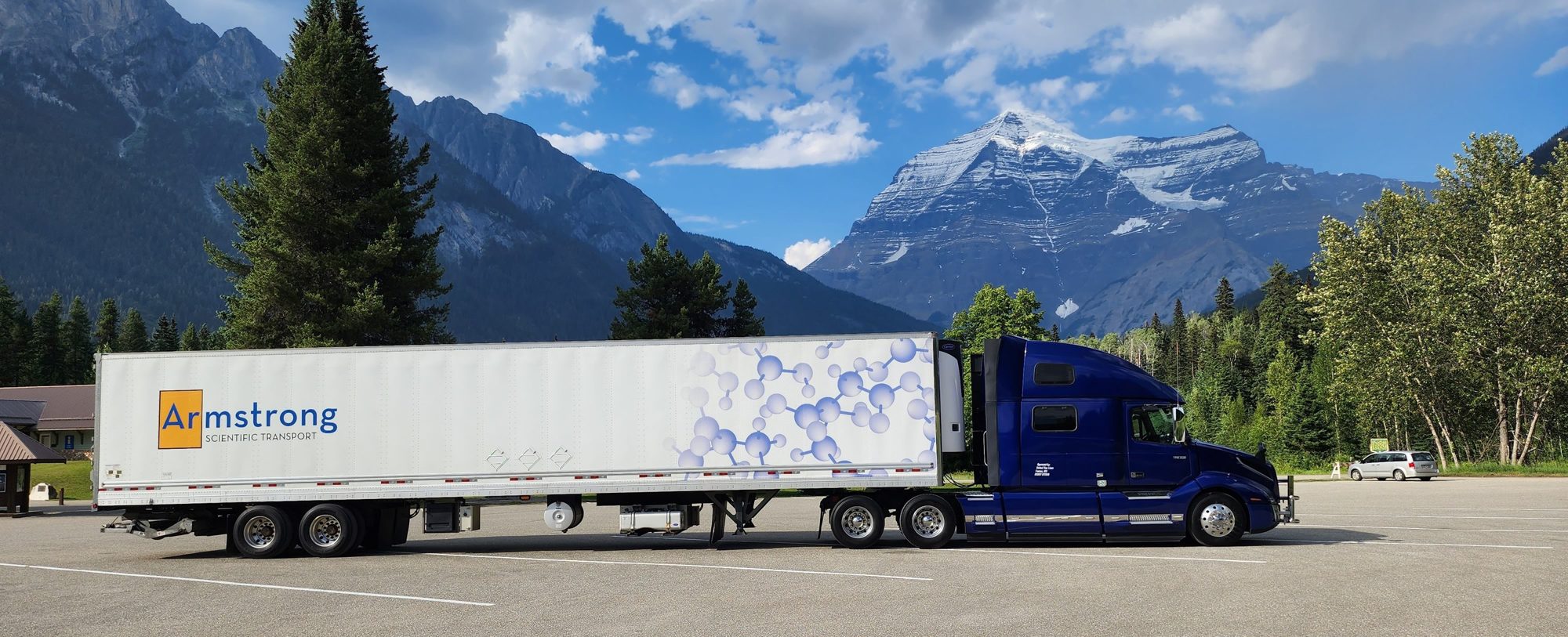
An Armstrong Scientific Transport truck at Mount Robson, British Columbia, on the Yellowhead Highway.
Cross-Border Lab Relocation: The Steps We Handle
- Inventory. We walk through the lab with you, in person or by video, and list what moves, what stays and what is disposed of.
- Permits. Some biological materials need a Canadian import permit from the Public Health Agency of Canada or the Canadian Food Inspection Agency. We help you and your new biosafety officer work out which items need one, early, because permits take time.
- Dangerous goods. Dry ice, chemicals and some samples are regulated in transport. Our crews are trained to IATA and Transportation of Dangerous Goods rules and prepare the shipping documents.
- Customs. We prepare the inventory and paperwork for Canadian customs and work with a licensed customs broker so the shipment clears without sitting at the border.
- Timing. We plan the pack-out around your last experiments and the delivery around your new lab’s readiness, so the freezers are not waiting on a loading dock.

An Armstrong Scientific Transport truck at the Pharmaceutical Sciences Building, University of British Columbia, Vancouver.
Working With Your New University
Your hiring university usually has a research office, a biosafety officer and a facilities team involved in your arrival. We provide a written quote and a move plan in a form those offices can review and approve, and we coordinate the receiving side directly with them. We serve universities across Canada and our parent company, Armstrong Moving Ltd., is a CAUBO member.
We also move labs within Canada and the United States, and overseas through our partner network. For a worked example of a full university lab move, read our University of Ottawa case study, and for planning tips see how to prepare for an international lab relocation.
For Research Offices, Facilities and Procurement
If your institution is bringing a researcher and their lab to Canada, this section is for you. We handle the move so your teams can focus on the arrival.
- One project manager. One person plans the move with the researcher, your research office, your biosafety officer and your facilities team, from the first walkthrough to reinstallation in the new lab.
- A quote your process can use. An itemised written quote and a move plan your research office and procurement team can review and approve.
- Biosafety and compliance. We work with your biosafety officer on import permits from the Public Health Agency of Canada and the Canadian Food Inspection Agency, and ship dry ice, chemicals and samples under IATA and Transportation of Dangerous Goods rules.
- Insured, with valuation coverage. We are insured and can provide valuation coverage for the relocation.
- Several recruits, one plan. If several researchers are joining you around the same start date, we plan their moves together so your receiving docks, freezer space and facilities staff are ready.
- Experience with Canadian universities. We are an approved supplier at most of the universities we work with, and have moved labs for the University of British Columbia, the University of Calgary, the University of Toronto and the University of Ottawa, to name a few.
To plan a move, call 905-795-6797 or email scientific@armstrongst.com with the researcher’s name, their current institution and their start date.

An Armstrong Scientific Transport truck on the University of Toronto St. George campus.
Frequently Asked Questions
How far ahead should I start planning a lab move to Canada?
Start three to six months before your start date. Import permits for biological materials and the customs paperwork take the longest, and freezer space at the new lab has to be ready before your samples arrive.
Do I need a permit to bring biological samples into Canada?
Some biological materials need a Canadian import permit from the Public Health Agency of Canada or the Canadian Food Inspection Agency. We help you and your new biosafety officer work out which items need one, early, because permits take time.
Can my samples stay frozen the whole way?
Yes. Samples travel at -80°C or colder, either inside running freezers in our powered transport or on dry ice, with the temperature logged for the whole trip so you have a record for your files.
Who pays for the move?
Who pays for your lab move depends on your offer and your new institution. Ask your new research office how your move is funded, and we will quote in the format they need.
Do you move labs from outside the United States?
Yes. We move labs into Canada from Europe, Asia and elsewhere by air or sea freight, with custom crating and customs handled at both ends.
How do I get a quote?
Call 905-795-6797 or email scientific@armstrongst.com with your current institution, your new one, your start date and a rough list of freezers and major instruments. We will set up a walkthrough.